
As an Amazon Associate, I earn from qualifying purchases. This article contains affiliate links at no extra cost to you.
The standing desk market has grown significantly in 2026, but is a standing desk actually better for you than a regular desk — or is it expensive hype? We looked at the research and the real-world experience to give you an honest comparison of standing desks vs regular desks for home office use.
Quick Verdict
Standing desks win for health when used correctly (alternating sit/stand), but a regular desk with a good ergonomic chair and proper setup is significantly better than a standing desk used poorly. The research supports sit-stand alternating, not standing all day. If you can invest in a quality standing desk ($450+), do it. If budget requires compromise, spend it on a better chair first.
Side-by-Side Comparison
| Feature | Standing Desk (Electric Height-Adjustable) | Regular Fixed-Height Desk |
|---|---|---|
| Price Range | $299–$799+ | $100–$400 |
| Health Benefits | High (when used with sit-stand schedule) | Moderate (with quality chair) |
| Stability | Very good (dual motor models) | Excellent (no moving parts) |
| Assembly | 60–120 minutes | 30–60 minutes |
| Lifespan | 5–15 years (with warranty) | 10–20+ years |
| Best For | Back pain, productivity focus | Budget builds, stability priorities |
Standing Desk (Electric Height-Adjustable) – In-Depth Review
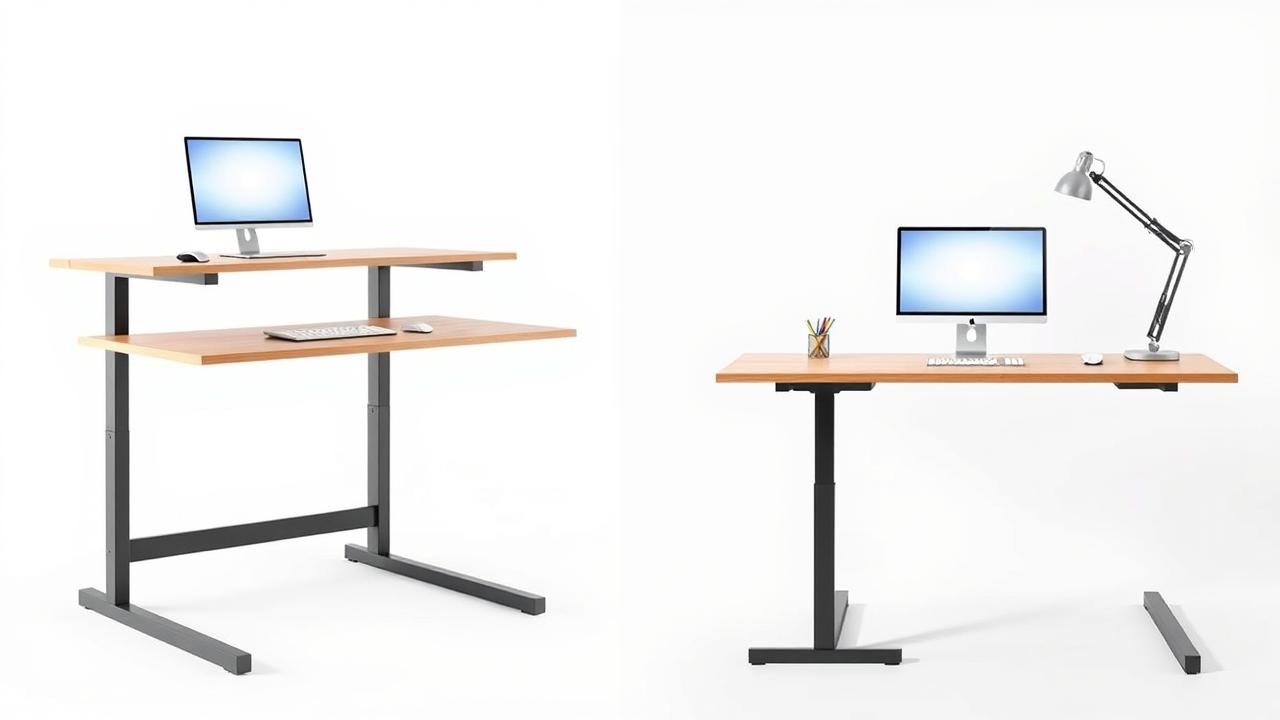
Electric standing desks allow you to transition between sitting and standing positions throughout the day. Research consistently shows that breaking up prolonged sitting with standing reduces back pain, lowers blood glucose spikes after meals, and may improve energy and focus. The key mechanism is position change, not standing specifically — movement is the benefit.
Design & Build Quality
Available in various desk sizes and materials. Electric models adjust height via motor-driven legs. Desktop can be any size from 40″–80″ wide. Premium models (FlexiSpot, Uplift) have anti-collision, memory presets, and 5–15 year warranties.
Performance & Stability
When used with a sit-stand schedule (30 min standing per 60–90 min of work), studies show measurable reductions in lower back discomfort, neck pain, and fatigue over a standard workday. Some users report improved afternoon energy and focus.
Features & Value
Memory presets, anti-collision, variable height, compatible with monitor arms and accessories. Some models include app connectivity for sit/stand tracking.
Best for: Active sitters, back pain sufferers, productivity optimizers
Price: $299–$799+
Pros:
- Research-backed health benefits for position alternation
- Reduces prolonged sitting risks
- Often improves afternoon energy levels
- Versatile — works for any type of work
Cons:
- $300–$800+ investment vs $100–$300 for regular desk
- Benefits only realized with proper use (sit-stand schedule)
- Assembly takes 1–2 hours
- Requires anti-fatigue mat for standing comfort
Regular Fixed-Height Desk – In-Depth Review
A high-quality regular desk at the correct ergonomic height, paired with a quality ergonomic chair, is the baseline for home office health. The limitation is that it doesn’t accommodate position change without leaving the desk. For users with sitting-associated health issues (back pain, hip flexor tightness, afternoon fatigue), a fixed desk provides no mechanism for relief.
Design & Build Quality
Standard fixed-height desks are set at approximately 28″–30″ — correct for approximately 5’8″–6’0″ users. Shorter or taller users need adjustable-height desks or accessories (risers, lower chairs) to work ergonomically.
Performance & Stability
Performance depends entirely on ergonomic chair quality and setup. A regular desk with a $1,400 Herman Miller Aeron properly configured outperforms a standing desk used poorly. The desk itself doesn’t affect health — what you do at it does.
Features & Value
Stable, lower cost, wider material variety (solid wood, glass, laminate). No electrical components to fail. Typically wider surface area per dollar than electric standing desks.
Best for: Budget-conscious buyers, users with good ergonomic chairs, non-prolonged sitting
Price: $100–$400
Pros:
- Significantly less expensive
- No electrical components to fail
- Stable — no wobble at any height
- Wider material and size variety per dollar
Cons:
- No position change capability during work
- Fixed height problematic for very short or tall users
- Can’t accommodate sit-stand health benefits without additional equipment
Standing Desk (Electric Height-Adjustable) vs Regular Fixed-Height Desk: Key Differences
What the Research Actually Says
Studies consistently show that prolonged sitting is a health risk — associated with increased cardiovascular risk, metabolic issues, and musculoskeletal pain. Studies also show that standing all day is equally problematic. The benefit of standing desks comes from facilitating position change (sit-stand alternating), not standing specifically. Any intervention that gets you up from seated position periodically achieves similar benefits.
When a Standing Desk Makes Sense
A standing desk is worth the investment if: 1) You currently experience back pain or afternoon fatigue from prolonged sitting. 2) You sit 6+ hours daily. 3) Your job involves focused computer work where you can easily alternate positions. 4) Budget allows $450+ for a quality dual-motor model. The benefit is real when you actually use the standing function — not as a display piece.
When a Regular Desk Makes More Sense
A regular desk makes more sense if: 1) Budget is under $400 — spend the difference on a better chair. 2) You have meetings or work activities that frequently take you away from your desk anyway. 3) You plan to use a standing desk converter instead. 4) You have no current back pain or prolonged sitting issues.
The Standing Desk Converter Compromise
Standing desk converters ($200–$350) sit on a regular desk and add standing capability without a new desk purchase. They provide the sit-stand benefit at a lower total cost. Limitations: smaller standing surface, can’t completely lower to seated desk level. If budget doesn’t allow a full standing desk, a converter on a regular desk is a legitimate middle ground.
Our Recommendation
Standing desks provide real, research-backed health benefits when used correctly. Regular desks with quality ergonomic chairs provide excellent ergonomic support for seated work. The best home office combines both: a standing desk when budget allows ($450+) paired with a quality ergonomic chair ($400–$1,400+). If budget requires choosing: prioritize the chair first, standing desk second. A poor chair causes damage regardless of what desk you use.
*Prices may vary. Always check Amazon for the current price.
See Standing Desk (Electric Height-Adjustable) on Amazon →
See Regular Fixed-Height Desk on Amazon →
Frequently Asked Questions
Is it worth switching from a regular desk to a standing desk?
Yes, if you experience back pain or afternoon fatigue, sit 6+ hours daily, and can invest in a quality dual-motor model. The research supports sit-stand alternating as beneficial. If you’re healthy and comfortable with your current setup, the ROI is lower.
Can I convert my regular desk to a standing desk?
Yes — standing desk converters ($200–$350) sit on top of your existing desk and add a standing position. They’re not as versatile as a full standing desk but provide the primary health benefit (position change) at a lower cost.
How long should I stand at a standing desk each day?
2–3 hours total across an 8-hour workday, in blocks of 20–45 minutes. Standing all day is not healthier than sitting all day — position change is the benefit.