
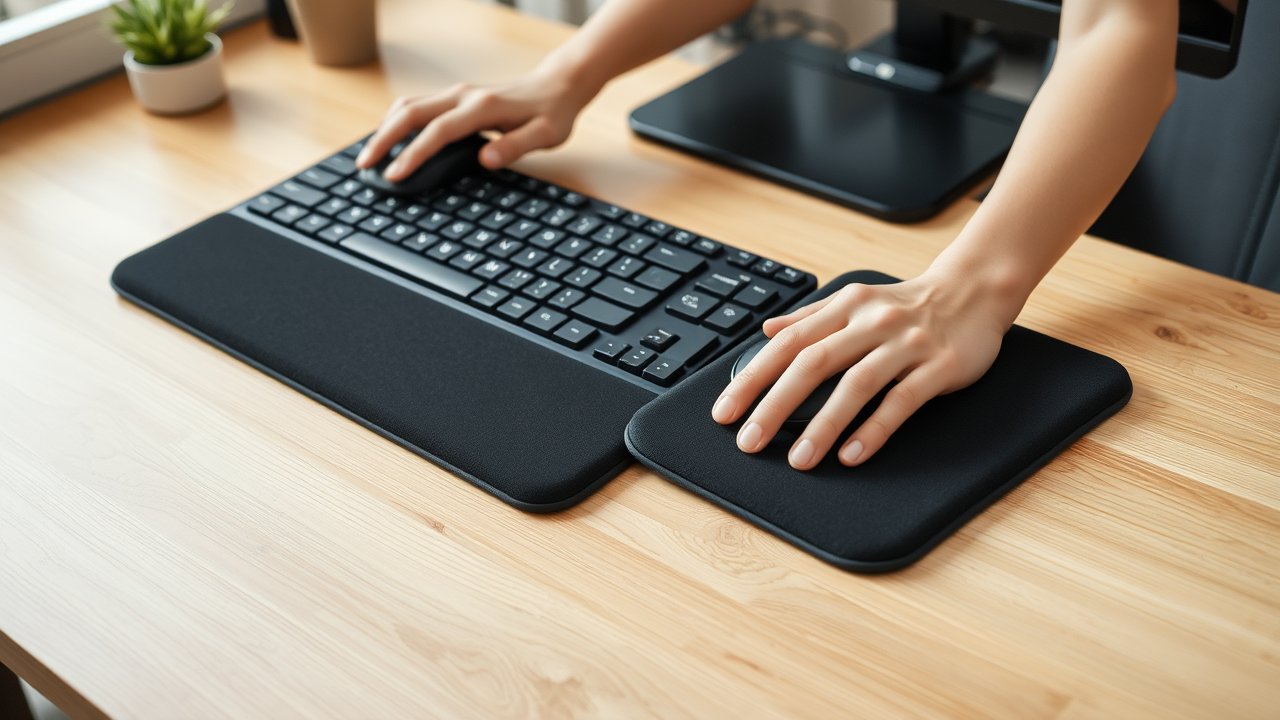
If you type or use a mouse for hours a day, the edge of your desk and the height of your keyboard can put steady pressure on your wrists. A wrist rest provides a soft, supportive surface that helps keep your hands at the right height and reduces contact pressure. But there’s a catch: used the wrong way, a wrist rest can actually make things worse. The best wrist rest is one that matches your keyboard height, supports the heel of your palm rather than your wrist joint, and encourages you to rest between bursts of typing – not while you type. In this guide, we compare six wrist rests for keyboards and mice, and explain exactly how to use them correctly.
As an Amazon Associate, I earn from qualifying purchases. This article contains affiliate links at no extra cost to you.
Quick Comparison Table
| Product | Price | Best For | Rating |
|---|---|---|---|
| Gimars Memory Foam Set | ~$20 | Best overall | ⭐⭐⭐⭐⭐ |
| Glorious Padded Wrist Rest | ~$25–$30 | Best for mechanical keyboards | ⭐⭐⭐⭐⭐ |
| 3M Gel Wrist Rest | ~$20–$30 | Best gel | ⭐⭐⭐⭐ |
| Logitech Palm Rest | ~$20 | Best for low-profile keyboards | ⭐⭐⭐⭐ |
| Wooden Wrist Rest | ~$25–$50 | Best style | ⭐⭐⭐⭐ |
| HyperX Wrist Rest | ~$20–$30 | Best cooling gel | ⭐⭐⭐⭐ |
Prices are approximate at the time of writing and may vary. Check Amazon for the current price.
Our Top Picks at a Glance
The Gimars Memory Foam Set is the best wrist rest choice for most people – it includes both a keyboard rest and a mouse pad with wrist support at an affordable price. For tall mechanical keyboards, the Glorious Padded Wrist Rest matches the height well. If you use a slim keyboard like the Logitech MX Keys, the Logitech Palm Rest is designed for that lower profile.
Reviews – The Best Wrist Rest Options for Keyboard and Mouse
1. Gimars Memory Foam Set – Best Overall
Gimars makes one of the most popular wrist rest sets on Amazon. The set includes an ergonomically shaped keyboard wrist rest and a mouse pad with a built-in wrist cushion. Both use memory foam covered with a smooth fabric, with non-slip rubber bases that keep them in place.
The memory foam is soft enough to be comfortable but firm enough to provide support. The shape slopes slightly to match common keyboard heights. Reviewers frequently mention its comfort and value.
Pros:
– Keyboard and mouse rests included
– Comfortable memory foam
– Non-slip base
– Affordable
Cons:
– Fabric can attract dust
– May be too low for tall mechanical keyboards
– Foam softens over time
2. Glorious Padded Wrist Rest – Best for Mechanical Keyboards
Mechanical keyboards are often taller than standard keyboards, which can force your wrists to bend upward. Glorious makes padded wrist rests in several sizes and thicknesses designed to match mechanical keyboard heights.
The stitched edges prevent fraying, and the soft padding is comfortable. Choose the size that matches your keyboard layout: full-size, tenkeyless, or compact.
Pros:
– Matches mechanical keyboard heights
– Multiple sizes
– Durable stitched edges
– Comfortable padding
Cons:
– Fabric absorbs oils over time
– Pricier than generic options
3. 3M Gel Wrist Rest – Best Gel
3M’s gel wrist rests are a long-time office staple. The gel conforms to your palm while providing consistent support, and the leatherette surface is easy to wipe clean.
Gel feels cooler than foam initially and holds its shape well. It’s a good choice for offices or anyone who prefers an easy-to-clean surface.
Pros:
– Supportive gel
– Easy-to-clean surface
– Durable
– Office-friendly look
Cons:
– Can feel firm
– Leatherette can wear over years
– Heavier
4. Logitech Palm Rest – Best for Low-Profile Keyboards
Low-profile keyboards like the Logitech MX Keys sit close to the desk, so a thick wrist rest would put your hands too high. Logitech’s palm rest is designed to match low-profile keyboards with a thin, comfortable cushion.
It has a smooth surface and a non-slip base. If you use a slim keyboard, this is a great match.
Pros:
– Designed for low-profile keyboards
– Thin and comfortable
– Clean design
Cons:
– Too low for taller keyboards
– Limited size options
5. Wooden Wrist Rest – Best Style
Wooden wrist rests look beautiful on a desk, especially with mechanical keyboards. They’re firm, easy to clean, and don’t absorb oils like fabric.
They’re harder than foam or gel, so they’re best for people who rest their hands only occasionally. Choose a height that matches your keyboard.
Pros:
– Beautiful, premium look
– Easy to clean
– Durable
Cons:
– Firm – less cushioning
– Can feel cold
– More expensive
6. HyperX Wrist Rest – Best Cooling Gel
HyperX makes wrist rests with cooling gel infused memory foam, which helps reduce heat during long sessions. They’re designed for gaming keyboards and come in sizes for different layouts.
They’re a good mix of comfort and cooling.
Pros:
– Cooling gel layer
– Comfortable memory foam
– Gaming keyboard sizes
Cons:
– Gaming aesthetic
– May be too tall for low-profile keyboards
How We Researched & Selected These Products
These picks are based on research and user reviews. We compared materials, heights, sizes, surfaces, and non-slip bases, and analyzed thousands of verified buyer reviews for comfort, durability, and how well each rest matches different keyboard types. We also considered ergonomic guidance on wrist posture and contact pressure from occupational health sources.
Buyer’s Guide – Choosing the Best Wrist Rest
Match the Height to Your Keyboard
The wrist rest should be roughly level with the front edge of your keyboard’s space bar. Too high or too low forces your wrists to bend. Low-profile keyboards need thin rests; mechanical keyboards need thicker ones.
Material
Memory foam is soft and comfortable. Gel is supportive and easy to clean. Wood is firm and stylish. Choose based on comfort and maintenance preferences.
Size
Match the length to your keyboard: full-size, tenkeyless, or compact. A rest that’s too short or too long can feel awkward.
Surface
Fabric is soft but absorbs oils. Leatherette and wood are easy to wipe clean.
Mouse Wrist Rests
Mouse wrist rests can help some people, but they can also encourage bending at the wrist. Consider a vertical mouse if you have wrist discomfort – see our guide to the best vertical mouse for wrist pain.
Price vs. Quality – What to Expect at Each Budget
- Under $20: Basic foam rests and sets.
- $20–$35: Better materials, durable edges, multiple sizes.
- $35+: Premium wood and designer options.
How to Use a Wrist Rest Correctly
This is the most important part:
- Rest between typing, not while typing. When you’re actively typing, your wrists should float slightly above the rest. Use the rest during pauses.
- Support your palm, not your wrist. The heel of your palm should touch the rest, not the underside of your wrist joint, where nerves and tendons are close to the surface.
- Keep your wrists straight. Don’t let your hands bend upward or downward.
- Don’t anchor and pivot. Avoid planting your wrist on the rest and pivoting your hand to reach keys – move your whole arm instead.
The OSHA computer workstation eTool on wrist rests explains these guidelines in more detail.
Wrist Rest vs. Ergonomic Keyboard
A wrist rest helps with contact pressure and wrist angle, but it doesn’t fix forearm rotation or shoulder width. An ergonomic keyboard addresses those issues. Many ergonomic keyboards include built-in palm rests. Combine either with a good desk pad for a comfortable typing surface.
Building a Wrist-Friendly Workstation
A wrist rest is one part of a bigger picture. Make sure your desk is at the right height – use our desk height chart – so your forearms are parallel to the floor. Keep your mouse close to your keyboard so you don’t reach to the side. Use keyboard shortcuts to reduce mouse clicks, and take short breaks every 30 to 60 minutes to stretch your hands and forearms. If you have persistent pain, numbness, or tingling, see a healthcare professional.
Simple Hand and Wrist Stretches for Desk Workers
Use these gentle stretches every hour or two. Stop if anything hurts.
- Wrist extensor stretch: Extend one arm in front of you, palm down. Use your other hand to gently bend the wrist downward until you feel a stretch on the top of your forearm. Hold for 15 to 20 seconds.
- Wrist flexor stretch: Extend one arm, palm up. Gently pull the fingers back toward you. Hold for 15 to 20 seconds.
- Finger spread: Spread your fingers wide, hold for five seconds, then make a gentle fist. Repeat five times.
- Shoulder rolls: Roll your shoulders backward ten times to release tension that often travels down to your wrists.
- Prayer stretch: Press your palms together in front of your chest and slowly lower them until you feel a gentle stretch.
These take less than two minutes and are a good habit to pair with a wrist rest. If you have persistent pain or tingling, consult a healthcare professional.
Mouse Wrist Rests: Do You Need One?
Mouse pads with built-in wrist cushions are popular, but they can encourage you to plant your wrist and move the mouse by bending it side to side. If you use one, keep the cushion under the heel of your palm and move from your elbow. Many people find that a vertical mouse or a larger mouse that fills the hand reduces the need for a mouse wrist rest altogether.
Common Mistakes to Avoid
- Resting your wrists while typing – it increases bending and pressure.
- Using a rest that’s too high or too low for your keyboard.
- Placing pressure on the wrist joint instead of the palm.
- Ignoring desk height – a wrist rest can’t fix a desk that’s too high.
- Pivoting at the wrist instead of moving your arm.
Frequently Asked Questions
Are wrist rests good or bad?
Wrist rests can be helpful when used correctly – supporting your palms during pauses and matching your keyboard height. They can be counterproductive if you rest on them while typing or press on your wrist joint.
Should I use a wrist rest while typing?
Ideally, no. Let your wrists float while typing and use the rest during pauses.
Do I need a wrist rest for a mechanical keyboard?
Most mechanical keyboards are tall enough that a wrist rest helps keep your wrists straight. Choose one that matches the keyboard’s height.
Is gel or foam better for wrist rests?
Foam feels softer and warmer; gel feels firmer and cooler. Both work well – it’s mostly personal preference.
Can a wrist rest help with carpal tunnel?
A wrist rest may reduce some pressure, but it isn’t a treatment for carpal tunnel syndrome. Consult a medical professional if you have symptoms.
What size wrist rest do I need?
Match the wrist rest to your keyboard layout. Full-size keyboards with a number pad need a long rest (around 17 inches); tenkeyless keyboards need a medium rest (around 14 inches); compact 60% or 65% keyboards need a short rest (around 12 inches). The rest should cover the area where your palms naturally fall.
How do I clean a wrist rest?
Wipe gel and leatherette rests with a damp cloth. For fabric-covered foam, spot clean with mild soap and water and let it air dry. Wood can be wiped with a slightly damp cloth.
Final Verdict
The Gimars Memory Foam Set is the best wrist rest for most people, offering comfortable support for both keyboard and mouse at a great price. Mechanical keyboard users should choose the Glorious Padded Wrist Rest, while slim keyboard users will appreciate the Logitech Palm Rest. Match the height to your keyboard, rest your palms during pauses rather than while typing, and combine your wrist rest with good desk ergonomics for the best results.